
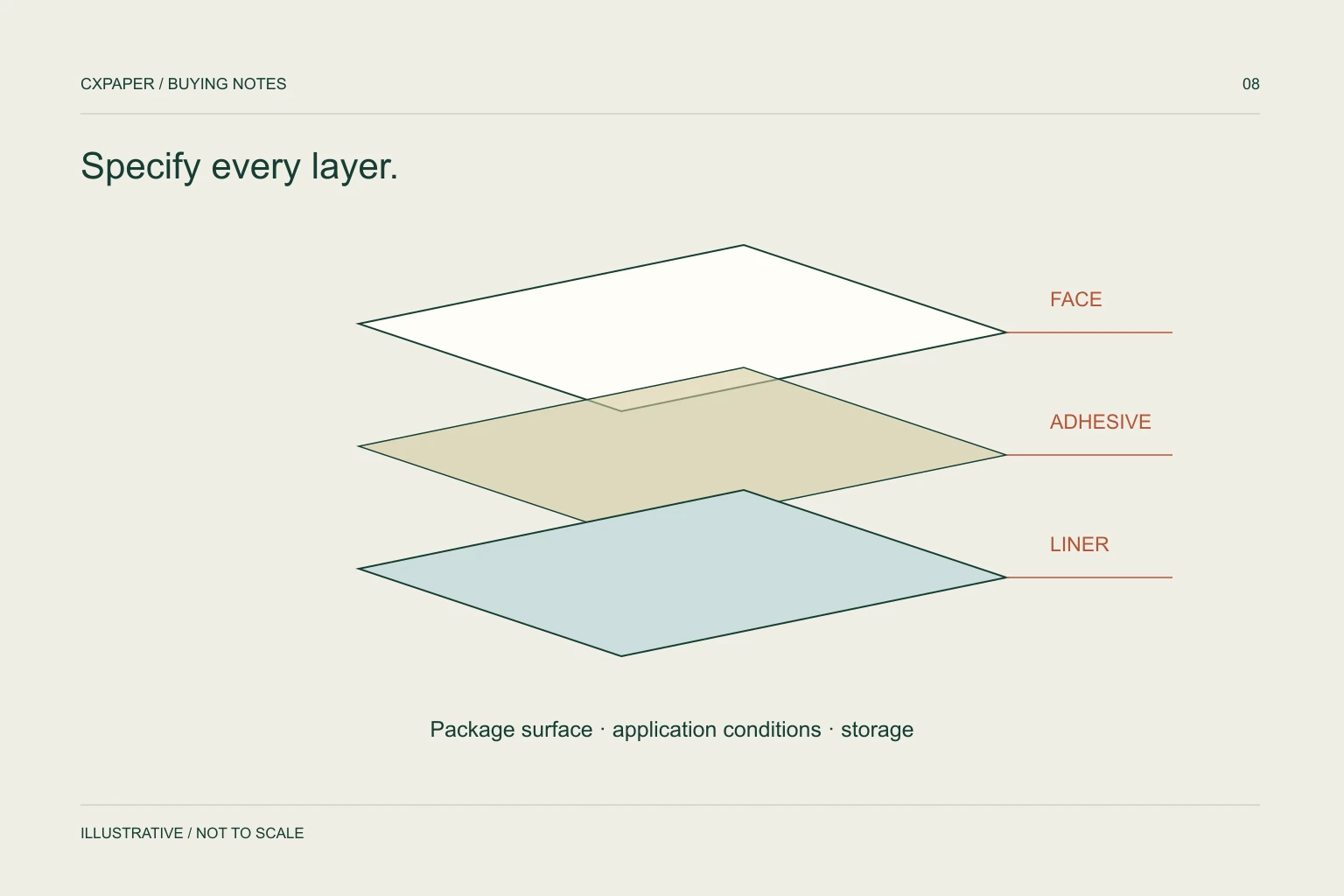
Choose a label adhesive by describing the surface, the temperature during application, later service conditions and whether removal is required. Evaluate the complete label on the actual package. Terms such as “permanent” or “strong adhesive” are not a substitute for a defined application.
Start with the surface, including its condition
A label that works on one package may behave differently on another. Record whether the contact surface is corrugated board, coated carton, glass, metal or a specific plastic. Include the finish: a rough board, glossy coating and flexible film create different practical conditions even when they carry the same product.
Zebra identifies surface material and shape as important selection inputs, including the difficulty of small curved surfaces. Use those principles to write a precise brief rather than asking only for more adhesive strength. Zebra’s label selection guidance explains the distinction.
Describe the package as it reaches the labelling station: clean or dusty, dry or damp, warm or chilled. A pristine laboratory sample may miss the condition that matters during normal packing.
Avery Dennison’s glass-packaging discussion illustrates why even containers described as glass need evaluation on the actual package.
Keep application and service temperatures separate
Application temperature describes conditions when the label is attached. Service temperature describes the conditions it later encounters. A label applied to a room-temperature carton before cold storage poses a different requirement from a label placed directly on an already cold package.
Ask for both limits in the proposed material data, then compare them with the actual workflow. A broad service-temperature range does not, by itself, establish that the adhesive can first bond at the coldest point in that range. Zebra separates these two measurements in its technical guidance.
Write the sequence as a short timeline: package leaves storage, label applied, waiting period, transport, final storage and removal if applicable. The timeline helps expose brief temperature changes that an average warehouse temperature would hide.
Define the outcome before choosing an adhesive family
| Required outcome | What to specify | What to check on a sample |
|---|---|---|
| Stay attached | Surface, handling and intended service period | Edge lift, movement and attachment after representative handling. |
| Remove cleanly | When it will be removed and from which surface | Residue, surface damage and label tearing. |
| Be repositioned | How often and at what stage | Whether the label can be moved and then stays in place. |
| Follow a curve | Container diameter, stiffness and label size | Whether corners or the trailing edge lift. |
“Permanent” describes a bonding intention; it does not promise a universal bond to every package. Likewise, “removable” needs a surface and removal interval. Avoid approving either word without defining the result that the receiving or operations team will judge.
Review the whole label construction
Adhesive performance is only one requirement. The face material must support the print method and the handling environment. The liner must feed and release as required. A stronger bond cannot solve an unreadable barcode, an unsuitable face material or a roll that does not fit the printer.
Ask the supplier to identify the proposed face material, adhesive and liner together. Keep the complete construction reference with the order so a repeat purchase does not accidentally preserve the label dimensions while changing the adhesive. If any component changes, agree whether another sample evaluation is needed.
For a thermal transfer label, include the ribbon in this record. It creates the printed image, while the adhesive determines attachment; the two choices solve different parts of the same application.
Avery Dennison also recommends evaluating the complete label construction for the specific application. Its adhesive technical guide treats performance as application-dependent.
Build a sample check around normal operations
- Use packages from the actual packing line, including the relevant surface finishes.
- Apply labels at the normal temperature with the normal method and pressure.
- Allow the intended interval before handling or storage.
- Expose samples to the expected sequence of handling and conditions.
- Inspect attachment, legibility and removal where required.
- Record the construction, conditions, observations and acceptance decision.
Agree acceptance criteria before reviewing the samples. For example, define where edge lift is unacceptable and what “clean removal” means for the package. A quick thumb-peel immediately after application is an observation, but it does not reproduce an entire distribution journey.
Where a customer specifies a formal test method, obtain that requirement and have the supplier address it directly. Do not replace it with an informal demonstration.
Send the operating conditions with the label dimensions
A useful request includes the printer and print method; label and liner dimensions; application surface; temperature at attachment; later temperatures; expected moisture, rubbing or chemicals; intended service period; and removal requirements. Include a photograph and, when practical, an actual package sample.
For repeat orders, save the approved construction and surface sample reference under one purchase code. If the packaging supplier changes a coating or film, revisit the label match even when the box dimensions remain identical.
Start with label paper and the print-method guide. These selection questions help define the request; availability and performance belong to the specific proposed construction.
Questions buyers ask.
Does permanent adhesive stick to any surface?
No. State the exact surface and operating conditions, then evaluate the proposed construction there. The word permanent does not establish universal compatibility.
Can a freezer-service label be applied while the package is frozen?
Only if its application requirements also allow that condition. Service temperature and minimum application temperature describe different stages.
Why can a label peel at the corners?
Surface condition, curvature, face-material stiffness and the adhesive match are possible factors. Record where and when lifting occurs so the supplier can evaluate the complete construction.
Is a stronger adhesive always the best choice?
No. A removable label, delicate surface or reuse process may need controlled removal. Select against the required outcome rather than strength alone.
Sources and scope.
Manufacturer references describe their own products or models. Use the instructions for your actual equipment and the agreed CXPAPER order specification.