
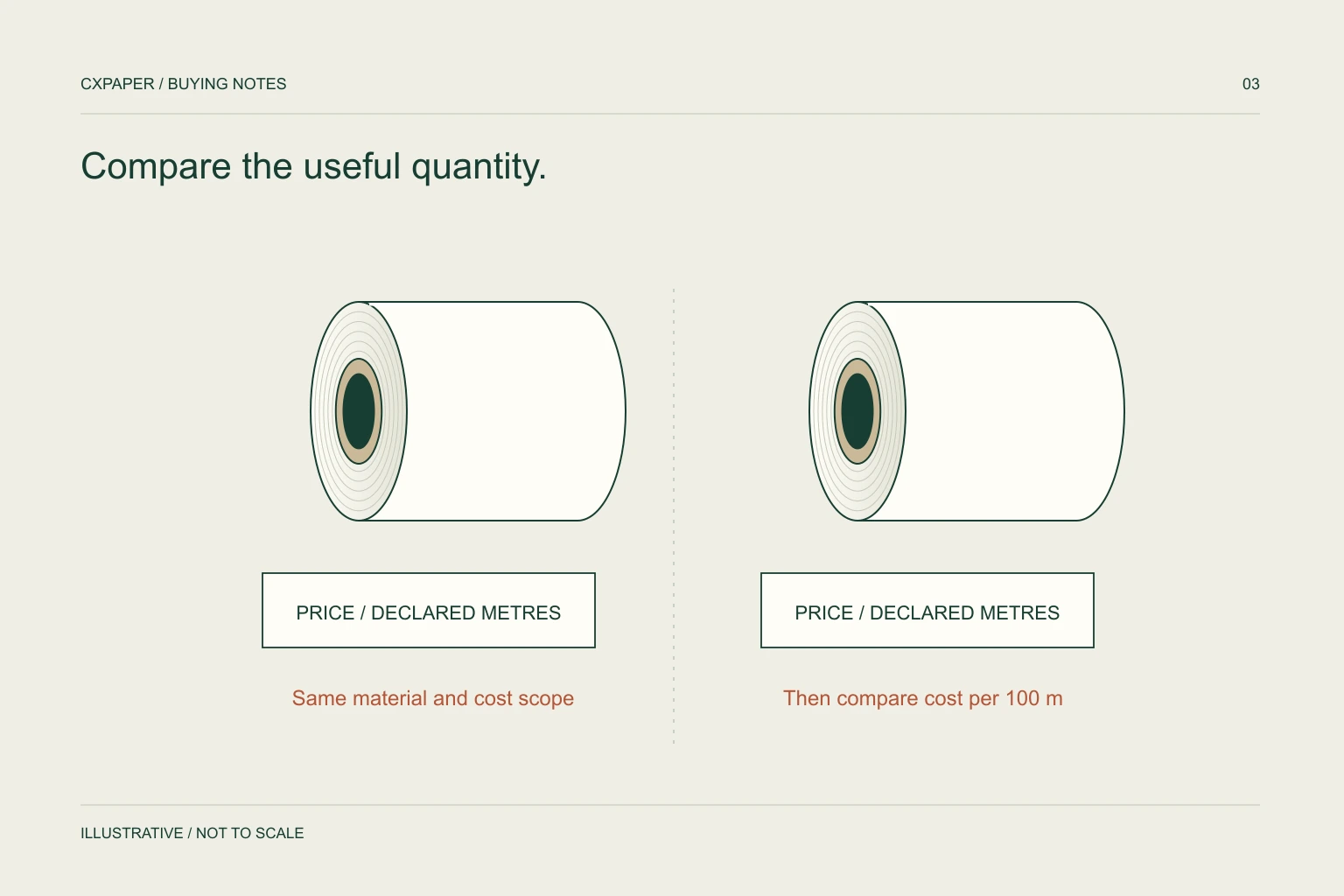
Compare quotations on an equivalent specification, then normalise the price to the quantity of paper supplied. For receipt rolls, cost per 100 metres equals price per roll divided by metres per roll, multiplied by 100. Include the same currency and cost scope in each comparison.
First make the products comparable.
A price difference is useful only when you understand what is different. A roll can cost less because it contains less paper, uses a different grade or arrives in a different packing configuration.
| Align this detail | Why it matters |
|---|---|
| Paper width and length | They define the useful paper quantity. |
| Paper grade and weight | These are part of the agreed product construction. |
| Roll diameter and core | They affect fit and construction. |
| Printed or unprinted | Artwork requirements change the order scope. |
| Packing quantities | Rolls per pack and carton determine the quoted unit. |
| Shipping and currency | Quotes need the same currency and included cost items. |
If the supplier quotes a carton, divide by the exact number of rolls in that carton before comparing a roll price. Keep the original carton details in your purchasing record.
Compare the paper quantity.
Enter two quotations in the same currency. This calculator compares only the price and declared length you enter. It does not assess quality, printer fit, taxes or freight.
In the example, quote B costs more per roll but less for the same paper length. That does not make it the better order on its own: the specification and included costs still need to match.
Keep the shipping scope visible.
Make a separate line for each cost you need to compare, such as freight, packing, inspection or destination handling. Avoid mixing a goods-only quote with a delivered price in the same headline comparison.
Ask the supplier to state the trade term and named place clearly. Have your logistics provider check the shipment assumptions and destination costs for your own route.
Also consider your operational requirements. A format that creates more replenishment work or requires different storage arrangements may not be equivalent for your business, even when paper cost is lower.
Keep the quote linked to its specification.
Save the supplier’s quotation beside the product specification, packing list assumptions and approved sample reference. Record any revision in one place so your purchasing and receiving teams are comparing the same order.
- Check the product and unit of price.
- Normalise paper quantity where useful.
- Align the included costs and destination.
- Review a sample against the application.
- Confirm the final order specification and terms.
Use the paper specification worksheet to collect the details, then prepare a CXPAPER enquiry.
Convert the quoted unit before calculating
The calculator takes a price per roll. If a quotation gives a carton price, first divide that price by the stated rolls per carton. Do not enter a carton price in one column and a roll price in the other.
| Illustrative quotation | Unit conversion | Input to the tool |
|---|---|---|
| A: 40 currency units for 50 rolls | 40 ÷ 50 = 0.80 per roll | Price 0.80; declared length 50 m |
| B: 54 currency units for 60 rolls | 54 ÷ 60 = 0.90 per roll | Price 0.90; declared length 60 m |
These hypothetical quotations reproduce the example in the calculator. They are not prices or packing configurations offered by CXPAPER. If the carton count is uncertain, leave the comparison unfinished and ask for that count; a guessed conversion produces a precise-looking but unreliable answer.
Use the same price basis for both inputs. Record the original currency, quotation date and cost scope in your worksheet rather than hiding a conversion inside the calculator. The result answers how much the entered quantity of paper costs. Your sample review, equipment requirements and commercial terms still determine whether the products are suitable alternatives.
Questions buyers ask.
Can I estimate paper length from roll diameter?
A geometric estimate requires paper thickness and the core outer diameter. It is not a substitute for the declared length and agreed product checks.
Should I compare by weight instead?
Weight can be useful for some purchasing arrangements, but it does not by itself establish usable length or printer fit. Match the unit to the specification and the intended use.
This guide is a purchasing worksheet and explanation, not a quotation or a test report. Final product specifications, sample terms and order conditions are agreed with CXPAPER.