
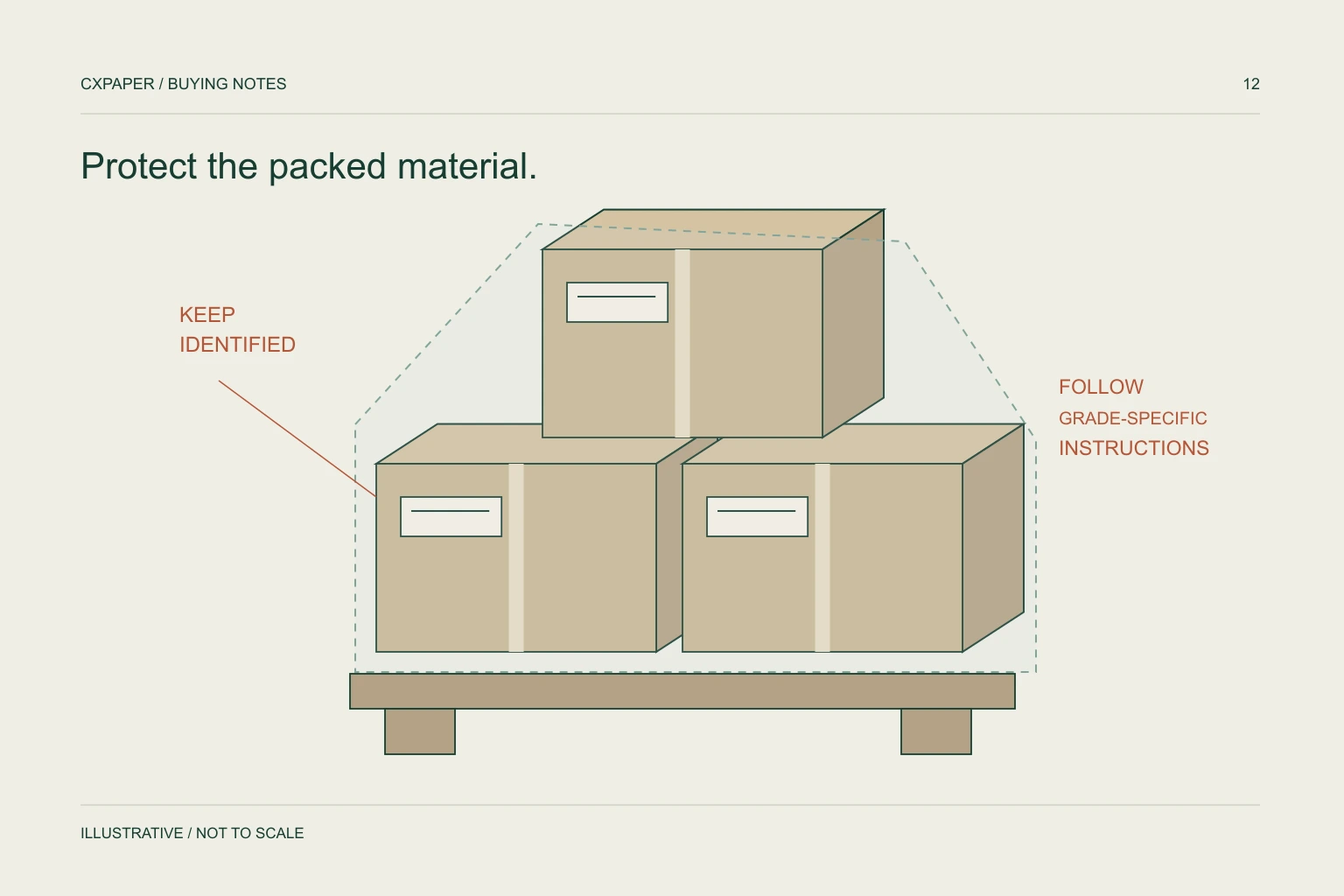
Protect paper from unsuitable moisture, temperature, light and physical damage throughout storage and transport. Keep the selected material’s storage instructions with the shipment specification, preserve protective packing and inspect arrival condition before distributing the stock.
Understand why the environment matters
Paper exchanges moisture with the surrounding air. Koehler explains that it can expand as it takes up moisture and contract as it loses moisture; this can affect dimensional stability. The practical implication is that a satisfactory sample and a damaged shipment may behave differently even when their purchase description is the same. Read Koehler’s dimensional-stability explanation.
Storage requirements are material-specific. A thermal coating, label adhesive and ordinary office sheet do not have identical sensitivities. Ask for the instructions that apply to the proposed grade or complete label construction, then pass them to the forwarder and receiving warehouse.
Do not use a printer’s storage-temperature rating as the rating for the paper inside it. Equipment and consumables can have separate limits.
Specify protection and identification before shipment
| Layer | What the buyer should confirm | Reason to record it |
|---|---|---|
| Product or inner pack | Count, wrapping and protection of roll or sheet edges | Supports quantity checks and protects handling surfaces. |
| Outer carton | Dimensions, gross weight, product identification and closure | Makes receiving and storage planning specific. |
| Pallet or shipment unit | Arrangement, support, protection and handling instructions | Avoids relying on an assumed loading pattern. |
| Documents | Packing list tied to product codes and units | Lets receiving reconcile mixed-product shipments. |
For a mixed order, show which product is in each carton and pallet. Similar white rolls or sheets are difficult to distinguish after inner packaging is separated. Keep the supplier’s material reference associated with the purchase code so an issue can be traced to the correct construction.
Discuss the real route with the logistics provider
Describe the origin, destination, transport modes, expected storage stops and handling method. A route can include an outdoor transfer, an unconditioned warehouse or a large temperature change even when the final office is comfortable. These details allow packing and handling proposals to address the actual journey.
Ask how cargo will be protected from water entry, crushing, shifting and contact with incompatible goods. Review any proposed moisture-control measure with the supplier and logistics provider instead of adding an arbitrary number of desiccant packs. The required arrangement depends on the load, packing and route.
Before dispatch, agree what evidence should accompany the shipment: carton identification, packing-list counts and useful photographs of the packed units. Photographs support receiving records; they do not prove the goods will remain undamaged throughout transit.
Keep packing intact while the material acclimates
Sappi’s technical guidance recommends allowing paper to acclimate in its original protective packaging and explains that the time depends on temperature difference and load volume. It also warns against storage in contact with damp concrete and near sources of extreme temperature change. These are useful handling principles, while grade-specific instructions take priority. See Sappi’s paper-conditioning guidance.
For a receiving plan, identify a clean, dry storage position, safe stacking arrangement and clear handling access. Keep unopened packs closed until needed and protect the remaining stock after a pack is opened. Avoid transferring loose paper into unlabelled containers that lose the grade and batch association.
Use a stock-rotation system linked to receipt and material identification. Rotation helps manage stock, but it does not extend a product’s stated storage life.
Add the checks required by thermal paper and labels
Koehler’s guidance for its conventional thermal papers identifies light, prolonged heat or humidity, and contact with substances such as oils, alcohol or plasticisers as factors that can affect print durability. Its stated storage conditions and durability terms apply to its materials, not automatically to other suppliers’ grades. Read the manufacturer’s thermal-paper guidance.
For receipt stock, ask how unused rolls and printed records should be handled, and distinguish blank-stock storage life from image retention. For labels, keep the face material, adhesive and liner identified as one construction. A bond or printed image that works before storage still needs to meet the intended use after that storage period.
When records have a required retention period, define that need at selection and use the organisation’s document-retention process. Do not infer archival suitability from the appearance of a newly printed receipt.
Inspect arrival condition before releasing the stock
- Match carton and pallet identification to the packing list.
- Record visible water exposure, crushing, broken wrapping or shifted loads.
- Separate affected units and preserve identification and photographs.
- Check representative inner packs for damage and the agreed quantity.
- Allow appropriate acclimation before a controlled print or feed review.
- Document any issue with the supplier before distributing affected stock.
Keep the report factual: product code, shipment reference, affected quantity, visible condition and observations from the intended equipment. Avoid assigning a cause from one photograph. A clear record helps the parties distinguish material, packing, transit and storage factors.
For the next order, feed the findings back into the order checklist and the relevant roll or label specification.
Questions buyers ask.
What is the correct storage temperature for all paper products?
There is no universal range for every sheet, thermal coating, adhesive and ribbon. Obtain the selected material’s instructions and plan storage around that specification.
Should I unwrap cold paper as soon as it arrives?
Follow the material guidance. Paper manufacturers advise acclimation in protective packaging; the appropriate time depends on the temperature difference and load, not a universal waiting period.
Does shrink wrapping make a shipment waterproof?
Do not infer a protection rating from the presence of wrap. Confirm the complete packing design and the exposure it is intended to address with the supplier and logistics provider.
Can a thermal-paper storage guide guarantee receipt retention?
Only a statement tied to the selected grade and its conditions can address retention. Blank-stock storage and the durability of an already printed image are separate questions.
Sources and scope.
Manufacturer references describe their own products or models. Use the instructions for your actual equipment and the agreed CXPAPER order specification.