
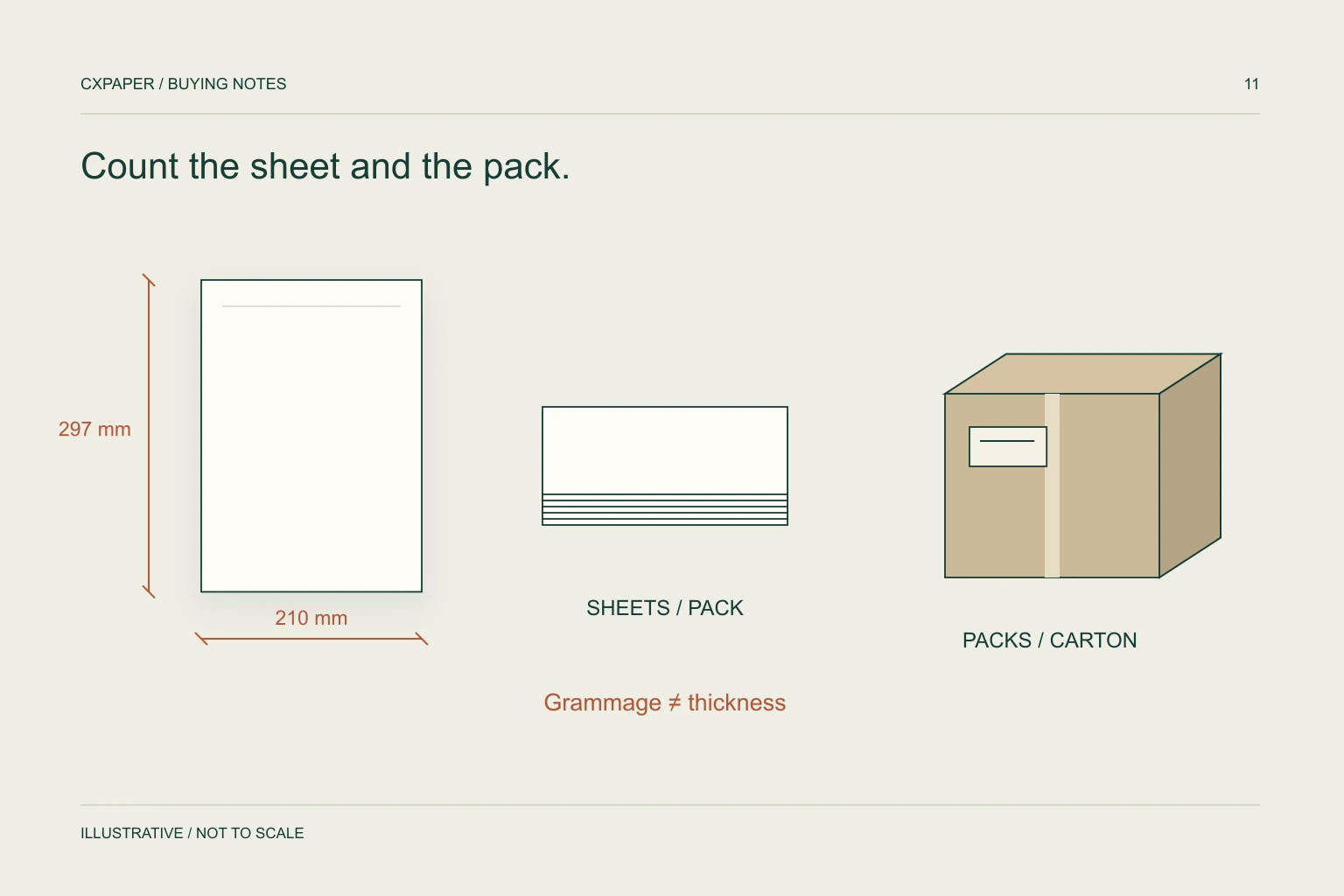
A4 paper measures 210 × 297 mm. Gsm describes its mass per square metre, not its thickness or a complete quality grade. Compare the intended printing performance, sheets per ream, reams per carton and packing configuration before deciding which quotation is better.
Understand what 70 or 80 gsm tells you
A gsm value is a grammage measurement. At the same sheet size and count, 80 gsm contains more paper mass than 70 gsm. It does not by itself establish thickness, opacity, whiteness, stiffness or how the paper will behave in your equipment.
Office-paper manufacturers describe these as separate performance considerations. Navigator’s product information, for example, discusses surface, opacity and suitability for document types alongside grammage. Use that separation when comparing grades, without transferring another manufacturer’s performance claims to the paper you are buying. See an office-paper grade description.
CXPAPER’s A4 information includes 70 and 80 gsm directions. Identify the required grade and printing job, then confirm the proposed paper and packing in the quotation.
Choose around the documents and equipment
| Use | What to evaluate | Useful sample content |
|---|---|---|
| Everyday office documents | Feeding, legibility and the normal output settings | Typical text pages and common forms. |
| Two-sided documents | Show-through and readability on both sides | Pages with the actual text and coverage. |
| Colour documents | Appearance, surface interaction and equipment suitability | Representative charts, logos and coloured areas. |
| Filing or external correspondence | Handling, desired feel and agreed document requirements | A complete document handled as it will be used. |
Check the supported media range and tray instructions for each printer. If an organisation has several devices, include the machines that matter most to the daily workload. A result on one printer is useful evidence for that device, but it does not establish universal feeding performance.
Use sheet mass as a planning calculation
A4’s area is 0.210 × 0.297 = 0.06237 square metres. Multiply that by gsm for the theoretical paper mass of one sheet. Multiply again by sheet count for the paper-only mass of a pack.
| Grammage | One A4 sheet | 500 sheets, excluding packaging |
|---|---|---|
| 70 gsm | 4.3659 g | 2.183 kg |
| 80 gsm | 4.9896 g | 2.495 kg |
These are arithmetic examples, not confirmed CXPAPER packing weights. They exclude wrappers, cartons, pallets and any material variation. Use the supplier’s declared net and gross shipping weights for freight planning; do not derive a container payload from this table alone.
The calculation is useful for spotting a quotation that confuses grams per sheet with grams per square metre. It cannot replace measuring the grade or counting a pack.
Define the quantity at every packing level
“One carton of A4” is incomplete. State sheets per ream or pack, reams per carton, cartons per pallet and the number of pallets. Have the carton and pallet dimensions, gross weights and any stacking restrictions recorded separately.
Do not treat a familiar 500-sheet pack as an automatic order term. The agreed CXPAPER arrangement must be written into its own quotation.
- Pack label: size, grammage, grade identification and sheet count.
- Carton label: pack count, product code and quantity.
- Pallet plan: footprint, height, carton arrangement and total weight.
- Receiving plan: which counts and condition checks will be recorded.
For private-label orders, keep the printed count consistent with the actual packing specification and artwork version.
Normalise price without losing the grade difference
For an equivalent grade, price per 1,000 sheets equals carton price divided by sheets per carton, multiplied by 1,000. Sheets per carton equals sheets per ream multiplied by reams per carton. Use the same currency and delivery-cost scope before comparing.
Illustration: a carton containing five packs of 500 sheets holds 2,500 sheets. Divide its price by 2.5 to obtain the price per 1,000 sheets. If another carton contains a different count, convert it separately rather than comparing the two carton prices directly.
Keep material and packing differences visible beside the normalised price. If one offer excludes a pallet or uses a different wrapper, the calculation does not eliminate that difference. Ask for revised comparable quotations when an important field is missing.
Approve a sample and preserve the specification
- Check the finished dimensions and stated grammage.
- Run representative documents on the intended machines.
- Inspect both sides where duplex use matters.
- Review the pack and carton identification, counts and physical condition.
- Save the approved grade, artwork and packing specification together.
Store unopened paper as directed for the selected grade, and protect opened stock between uses. The storage and shipping guide explains the questions to put into the logistics brief.
Start from A4 copy paper, and include order quantity with its unit, destination and intended printing use. For branded packaging, also use the OEM order checklist.
Questions buyers ask.
Is 80 gsm always better than 70 gsm?
Not by grammage alone. Compare the actual grade against printer requirements, document appearance and handling needs, especially when duplex printing matters.
Does every ream contain 500 sheets?
Do not assume the order count from the word ream. State sheets per pack and packs per carton explicitly on the quotation and packing artwork.
How much does 500-sheet A4 paper weigh?
The theoretical paper-only mass is about 2.183 kg at 70 gsm or 2.495 kg at 80 gsm. Wrappers and cartons add weight; use declared gross weight for transport.
Is A4 copy paper suitable for a direct thermal printer?
Ordinary office copy paper and direct thermal media are different products. Follow the printer’s required medium rather than matching only the A4 sheet size.
Sources and scope.
Manufacturer references describe their own products or models. Use the instructions for your actual equipment and the agreed CXPAPER order specification.