
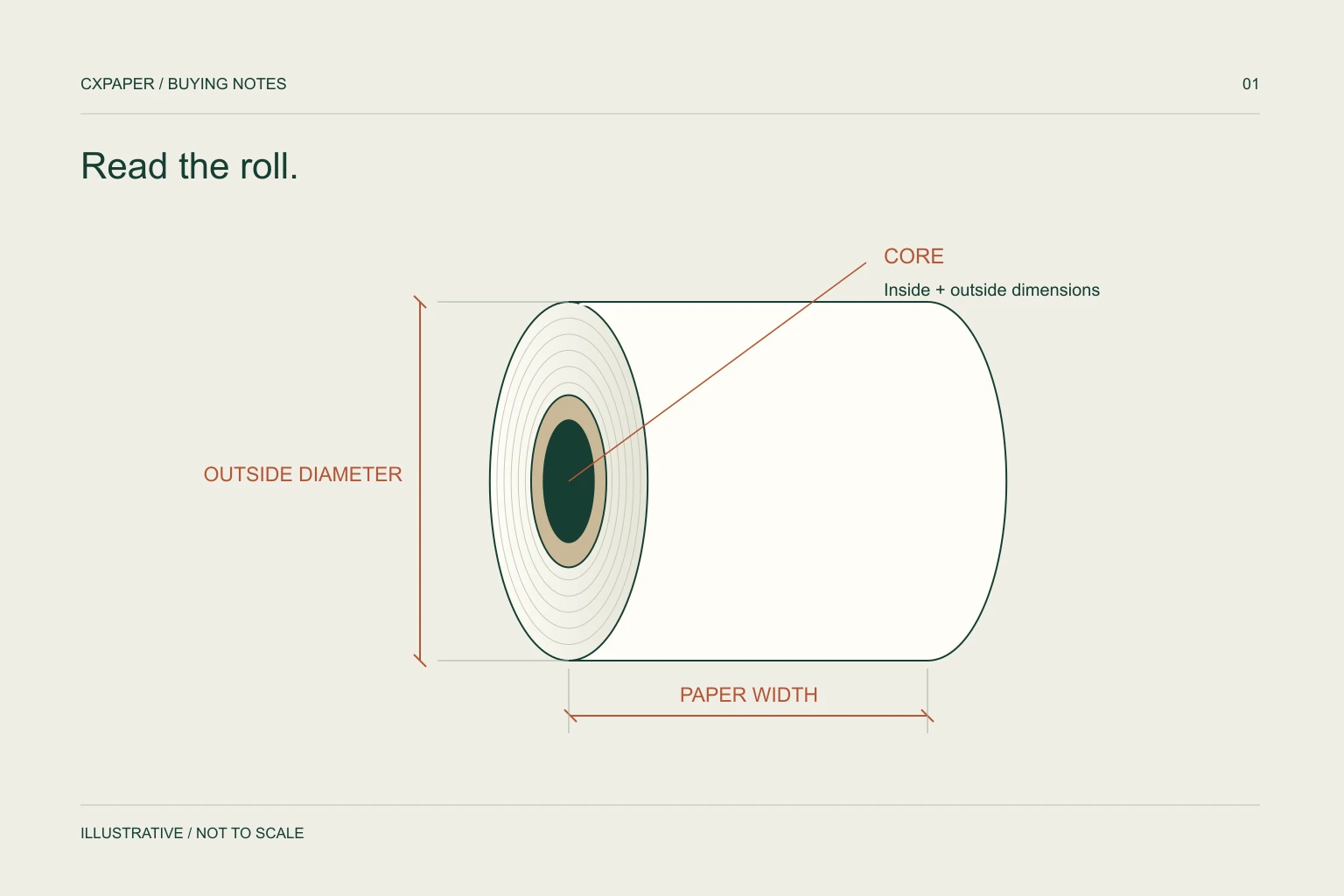
To specify a thermal paper roll, confirm the paper width, maximum roll outside diameter, core dimensions and paper requirements in your printer manual. A size shorthand such as “80 mm” does not describe the complete roll.
The dimensions that do different jobs.
Write each dimension in a separate field. Avoid sending an unlabelled pair of numbers: it leaves room for a supplier and buyer to interpret the same brief differently.
| Parameter | What it tells you | What to include |
|---|---|---|
| Paper width | The width of the paper web across the print path. | Width in mm, with the printer model. |
| Roll outside diameter | The overall size of the wound roll. | Maximum accepted roll diameter in mm. |
| Core inner diameter | The opening through the centre of the core. | Core ID, and any holder or adapter requirement. |
| Core outer diameter | The diameter at which paper begins winding. | Core OD when comparing construction or calculating length. |
| Paper length | The quantity of paper wound on the roll. | Declared metres per roll, with the paper grade. |
Read the printer manual first.
Printer manufacturers document media requirements separately. For example, Epson’s TM-T20IV-L technical reference includes paper width, roll diameter, core diameter and paper thickness. Those values apply to that model; they are not general specifications for every POS printer.
Before you replace a roll, record the exact model from the printer label. If several models are in use, group them by their supported media rather than by an assumed common paper width.
- Find the printer’s paper or media specification section.
- Record each permitted dimension with its unit.
- Compare the proposed roll against all relevant limits.
- Evaluate a sample in the actual printer before a broader order.
What “80 × 80” leaves out.
When a supplier uses width × roll diameter, “80 × 80 mm” means an 80 mm paper width and 80 mm outside roll diameter. Always confirm how the supplier labels the dimensions. It still leaves the core, paper thickness and length unspecified.
Two rolls can have the same outside diameter and hold different paper lengths. The core construction and paper thickness affect the amount of paper that fits into the roll. Paper weight in gsm is not the same measurement as thickness.
For a quotation, request the actual paper length rather than inferring it from a product name. Use cost per 100 metres only after aligning the other product requirements.
Put the dimensions into a useful enquiry.
A strong enquiry separates a known requirement from a question for the supplier. If you do not know the core specification, give the printer model instead of inventing a number.
Product: thermal receipt paper
Printer: [your model]
Paper width: [mm]
Maximum roll diameter: [mm]
Core ID / OD: [mm, if known]
Target paper length: [metres]
Paper weight: [gsm, if required]
Quantity: [number and unit]
Packing and delivery country: [your requirements]
CXPAPER’s thermal receipt paper range lists 57 mm and 80 mm widths, with size, weight, logo and packing customisation. Use those as starting points and confirm the complete specification for the order.
Review thermal paper roll options or download the procurement brief.
Keep a fit record for the next order
When a sample fits, record more than a photograph of the installed roll. Note whether the sample was a full roll, which holder or adapter was used and which paper settings were selected. A half-used roll cannot demonstrate that the full outside diameter fits the compartment.
Keep the printer manual revision with the dimensional record. If an equipment model is replaced across your stores, review the media requirements before reusing the previous order code. A familiar nominal width should not override the new printer’s documented limits.
For a mixed fleet, a simple register can list each printer model, location, width, maximum roll diameter and current roll reference. Ask the supplier to identify any proposed differences from that register. This makes a replacement decision traceable and reduces the chance that a packing change or a core change goes unnoticed.
Once the specification is agreed, retain the sample identity, quoted metres per roll and pack count with it. The same record then supports purchasing, stock identification and receiving checks. See the 57 mm versus 58 mm guide for nominal-width terminology and the 80 × 80 length guide for the limits of estimating paper quantity.
Questions buyers ask.
Does a 57 mm roll fit a 58 mm printer?
Do not decide from the marketing name alone. Use the actual media dimensions and tolerances supported by the specific printer.
Does higher gsm mean a longer roll?
No. Gsm measures mass per unit area. Roll length depends on its construction, including paper thickness and the space between the core and outside diameter.
Sources and scope.
Manufacturer references describe their own products or models. Use the instructions for your actual equipment and the agreed CXPAPER order specification.