
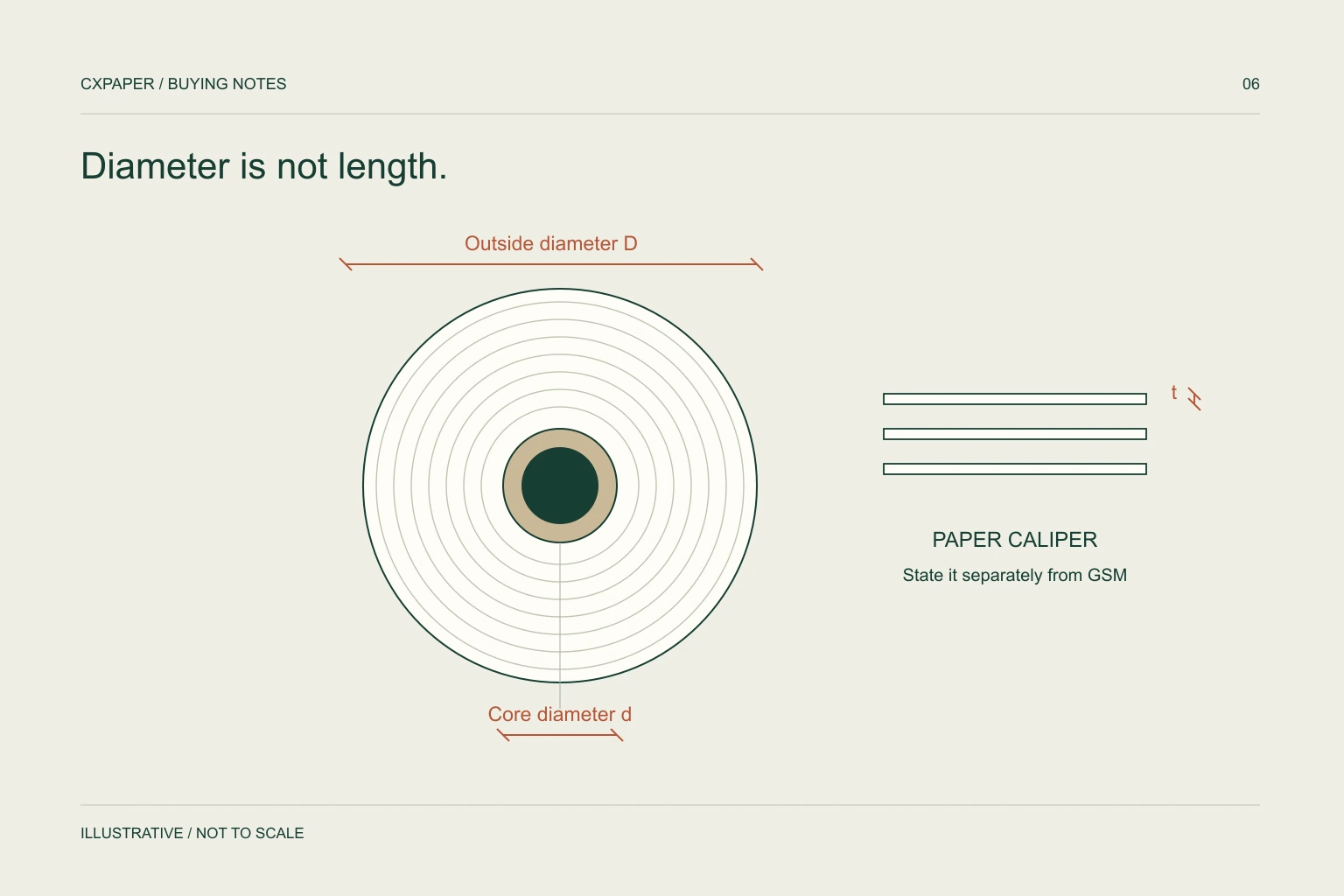
If “80 × 80 mm” means paper width × roll outside diameter, it does not define the paper length. Length also depends on the core outside diameter, paper thickness and winding. Ask for declared metres per roll; use a calculation only as an estimate with stated assumptions.
Read each part of the roll description
In a width-by-diameter description, the first 80 mm describes the web across the print path; the second describes the outside of the full roll. Neither number means 80 metres. Some suppliers use other naming conventions, so have the dimensions labelled on the quotation.
The printer’s capacity also needs a separate check. Epson’s TM-m30 manual, for example, distinguishes paper width, maximum roll diameter and core outside diameter rather than collapsing them into one size name. Use your own model’s requirements when ordering. Epson’s specification layout is a useful illustration of the distinction.
Estimate length from the wound cross-section
For an ideal, evenly wound roll, the paper occupies an annulus: the area inside the roll outside diameter minus the area occupied by the core. Dividing that area by paper thickness estimates the unwound length. This is a geometry calculation, not a test result or a supplied specification.
L ≈ π × (D² − d²) ÷ (4 × t × 1,000)
D = roll outside diameter in mm; d = core outside diameter in mm; t = paper thickness in mm.
Use core outside diameter, not the opening. Convert micrometres before calculating: 60 μm is 0.060 mm. Mixing millimetres and micrometres creates a thousandfold error. Paper width cancels from this geometric calculation; it still matters for printer fit and paper mass.
See how thickness and core change the estimate
| Roll OD | Core OD | Assumed thickness | Estimated length |
|---|---|---|---|
| 80 mm | 12 mm | 0.060 mm | 81.9 m |
| 80 mm | 18 mm | 0.060 mm | 79.5 m |
| 80 mm | 12 mm | 0.070 mm | 70.2 m |
The first and third examples share the same outside dimensions yet differ by about 11.7 metres. The difference comes from the assumed thickness. The first and second instead show what happens when the core uses more of the available space.
These figures cannot identify an unmeasured roll. Real winding, paper compression, dimensional variation and the accuracy of the thickness measurement affect the result. Round an estimate sensibly and keep it separate from the supplier’s declared and agreed length.
Do not substitute gsm for thickness
Grammage, expressed in grams per square metre or gsm, measures mass per area. Caliper measures thickness. Two grades with the same grammage need not occupy the same volume, so a gsm value cannot simply be entered into the thickness field.
A separate mass-based estimate is possible when the net paper mass, actual width and grammage are known: length in metres equals net paper mass in grams divided by the product of paper width in metres and grammage in g/m²: L = M ÷ (w × g). Parenthesise the denominator as width × gsm. Remove the mass of the core, wrapping and other packing before using it.
Use this only as a cross-check. A kitchen-scale measurement of the entire packaged roll is not proof of metres delivered, and an assumed grammage introduces another unknown.
Compare equal material before comparing cost per metre
First align width, paper grade, required image performance, core, declared length, printing and packing. Then normalise price with: price per roll ÷ metres per roll × 100. Use the same currency and the same delivery-cost scope for both offers.
A lower cost per 100 metres may be useful for equivalent rolls, but it does not resolve a fit problem or compensate for an unsuitable paper grade. A longer roll also needs to remain within the printer’s diameter limit. Ask the supplier which field is the controlled requirement if a target length and maximum diameter are both specified.
The quotation comparison guide includes the buying logic behind the calculation.
Write the length requirement into the order
- State width, full-roll OD limit and core ID/OD in separate fields.
- Record target or declared length in metres per roll.
- Specify the paper grade, gsm and caliper where relevant.
- Agree any permitted variation and how length will be checked.
- Keep the approved sample and packing description linked to the same specification.
For replenishment, retain the specification with the purchase code rather than ordering from a photograph of “80 × 80”. At receiving, compare the carton identification and roll construction with that record. Any unexpected difference is easier to resolve when the original quote states both dimensions and length.
Begin an enquiry from thermal paper rolls and include the quantity, unit and destination.
Questions buyers ask.
How many metres are in an 80 × 80 roll?
There is no single answer from that shorthand. Ask for the actual length and the paper/core construction; the calculated examples here are assumptions, not product lengths.
Can I calculate length using core inner diameter?
Use core outside diameter in the geometry formula. Core inner diameter describes the central opening and would overstate the space available for paper.
Does lower gsm always mean more metres?
No. Thickness, core and winding govern the geometric space. Gsm alone does not tell you the thickness or the finished roll length.
Which value should decide a quote comparison?
Compare equivalent material and construction, then use the declared metres per roll to calculate cost per 100 metres. Also align packing and delivery terms.
Sources and scope.
Manufacturer references describe their own products or models. Use the instructions for your actual equipment and the agreed CXPAPER order specification.